

Welcome to Long Story / Short. Practical insights on AI, product leadership, and the future of work. Depth when it matters, clarity always. I’m glad you’re here. Let’s get into it.
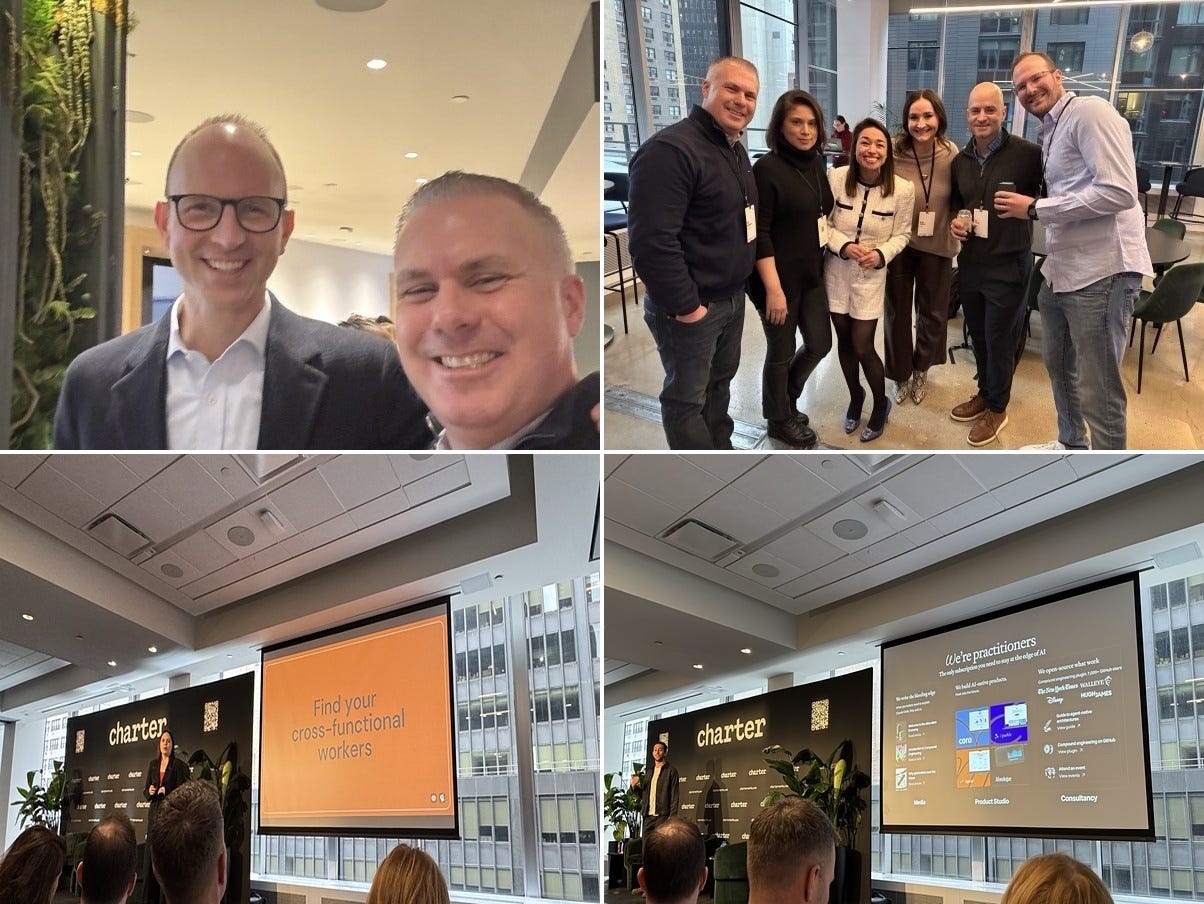
Yesterday I spent the day at Charter’s Leading with AI Summit in NYC. The through line: companies are deep in the messy middle of AI adoption, and the ones pulling ahead are doing it with better leadership, clearer frameworks, and the confidence to experiment in the open.
👉 I built an interactive map of the summit’s speakers, themes, and connections.
Here’s what I keep thinking about.
The Great Inversion
Sebastian Siemiatkowski (Klarna) closed the day with the story I can’t shake. Klarna started their AI journey by replacing 600 customer service agents with AI. Revenue per employee went from $300K to $1.3M. Average comp up 60%. But he now believes the last job humans keep will be talking to customers. The function AI replaced first becomes the last human role. They’re even hiring their own customers as service reps. A process that started by eliminating customer service ends with humans as the voice of the customer. I’m still processing that one.
Nine years in, IBM has the receipts
Nickle LaMoreaux has run IBM HR as “Client Zero” since 2017, testing every AI product internally before it ships. They shut down their HR phone line and email overnight. 40% reduction in HR operating costs. Her framework: eliminate, simplify, automate, in that order.
The power user gap is the story of 2026
Aaron “Ronnie” Chatterji (OpenAI) brought the data: 95th-percentile enterprise users are running far more compute-intensive tasks than median users, and the gap is widening fast. This closes with change management from the top, not bottom-up experimentation alone.
Start with a baby elephant
Katy George (Microsoft) shared that their sales team’s AI adoption went from 25% to near zero to 80%. The difference wasn’t better tools. It was sitting with reps, understanding their workflows, and building AI directly into how they sell. Iavor Bojinov (Harvard Business School) put it perfectly: “If you want an elephant, start with a baby elephant. Don’t feed a squirrel and hope.”
The Four T’s for enterprise adoption
Mary Alice Vuicic (Thomson Reuters) hit 80% AI adoption with 400+ use cases by co-leading the effort between HR and technology. Her framework: Tone, Training, Tools, and Time. Jonathan Marek (Guild) added the right counterpoint: make AI ordinary, not exceptional. There’s no “Chief Internet Officer.” This shouldn’t be different. Guild saw 20%+ efficiency gains using Sierra for customer support with 4.8/5 CSAT scores.
Four skills AI can’t touch
Melanie Rosenwasser (Dropbox) and Heather Stefanski (McKinsey) kept coming back to awareness, judgment, adaptability, and connection. Dropbox is going analog as a counterweight: offsites with no devices, meditation, journaling. McKinsey redesigned interviews around a video game that tests real-time problem solving you can’t prep for.
Cross-functional leaders will own this moment
Rebecca Hinds (Glean) shared research showing cross-functional workers are the most effective AI champions and far more likely to build successful agents. They see the bottlenecks and handoffs others miss. As someone who’s built a career connecting dots across organizations, I was smiling ear to ear. She also dropped a stat that stopped the room: 41% of YC AI startups automate tasks workers prefer to keep. Don’t automate the soul of work.
Just start building
Brandon Gell (Every) gave the most hands-on session of the day, especially for this largely non-technical audience. He built a Spanish tutor app and in-house paralegal using plain English and Claude Code. No technical background. His mantra: “Ask the alien superintelligence!” Any question you have about these tools, just ask the AI itself. For many in the room, this was the moment the energy shifted from “someday” to “maybe tonight.” As a non-technical builder who’s been using these tools daily, I can confirm: the barrier to entry is gone.
Workslop is real
Gabriella Rosen Kellerman (BCG) named it: AI-generated content that looks like work but lacks substance. Hannah Calhoon (Indeed) added the kicker: if you punish people for finding efficiency by handing them 30% more work, they’ll stop looking.
Coaching at scale
Hilary Gridley (former Head of Product, WHOOP) showed how custom GPTs can deliver feedback on demand. Her framing: 80% as good as what she would do, but available instantly. That beats perfect human feedback you wait three days for.
The journalist lens
Gina Chua (Semafor / CUNY) made the case for leaning into what AI does best: language. At CUNY she’s building tools that read every newsletter and surface trends, work that would have been impossible to staff for. Alyson Shontell (Fortune) predicted 2026 is when AI shifts from cost-cutting to growth. If Gina’s work is any indication, she’s right.
Putting real metrics on “AI skills”
Kenneth Matos (HiBob) is running global research with 5,000 people to build an assessable framework for AI skills. When he asked people what they mean by “AI skills,” the answer was “generative AI?” You can’t put that in a job description. Research drops in Q2.
The thing I keep coming back to: the companies getting this right aren’t treating AI as a tool rollout. They’re asking what work should look like when humans and machines each do what they’re best at. That’s a leadership question, a culture question, and a question about meaning.
Charter is worth every penny. Small team, big impact. If you’re leading through the AI transition and not subscribed, do it!
This is Long Story / Short. If this was useful, subscribe and come along for the ride.